Start with a budget-friendly batch-cooking plan
Batch cooking on budget works best when it begins with a plan rather than an heroic pile of groceries. A sensible system gives each ingredient more than one job, while leaving enough room for changing appetites and the occasional emergency toast dinner. The aim is not culinary perfection; it is a week of decent meals without a fridge full of expensive good intentions.
Set a realistic weekly food budget
A useful budget starts with what the household can actually spend, not a fantasy figure that collapses by Wednesday. The cook can review recent receipts, separate food from household items, and set aside a small amount for staples already running low. A workable budget beats wishful maths because it gives the plan something solid to lean on.
The figure should cover the whole eating pattern, including lunches, snacks, breakfast ingredients, and the odd meal that cannot be packed neatly into a container. Once the limit is clear, the cook can decide which meals deserve the best ingredients and where a cheaper substitute will do perfectly well.
Choose meals that share affordable ingredients
The most economical menu has overlap without becoming monotonous. A tray of roasted vegetables might accompany lentils, fill a wrap, and brighten a grain bowl, while a pot of tomato sauce can move between pasta, soup, and beans. The trick is to share building blocks, not force every meal to taste like the same Tuesday.
Before shopping, the cook can choose two or three main preparations and list their common ingredients. Onions, carrots, rice, tinned tomatoes, eggs, and legumes often earn their place because they work across several formats and do not demand a parade of expensive extras.
Calculate portions before you start cooking
Portion maths is gloriously unglamorous and highly effective. The cook should count how many lunches and dinners are needed, then allow for meals eaten elsewhere, leftovers, and days when a larger serving will be welcome. Cooking eight portions for a household that needs five is not frugality; it is an invitation to grow freezer fossils.
Serving containers provide a helpful reality check. If there are only four suitable lunch boxes, the batch should either be smaller or include a storage plan before the chopping begins. This simple check prevents both undercooking and the costly habit of letting perfectly good food become mysterious fridge archaeology.
Build a flexible menu around sales and pantry staples
A flexible menu starts with what is already available, then bends around useful specials rather than chasing every discount. Pantry staples can anchor the week, while seasonal vegetables and marked-down items supply variety. The result should be a plan with a backbone, not a rigid timetable that treats a bruised capsicum as a personal betrayal.
It helps to write meals as categories instead of fixed recipes: one bean dish, one grain bowl, one soup, and one egg-based meal, for example. That approach makes substitutions easy when the shop has better carrots than zucchini or the pantry contains chickpeas instead of lentils.
Shop smarter for maximum meal mileage
A low-cost shop is less about buying the cheapest object in every aisle and more about buying ingredients that travel well across several meals. Fresh food still matters, but it needs a supporting cast of grains, legumes, eggs, tins, and flavourful basics. A little planning turns a trolley into a week of possibilities rather than a collection of unrelated bargains.
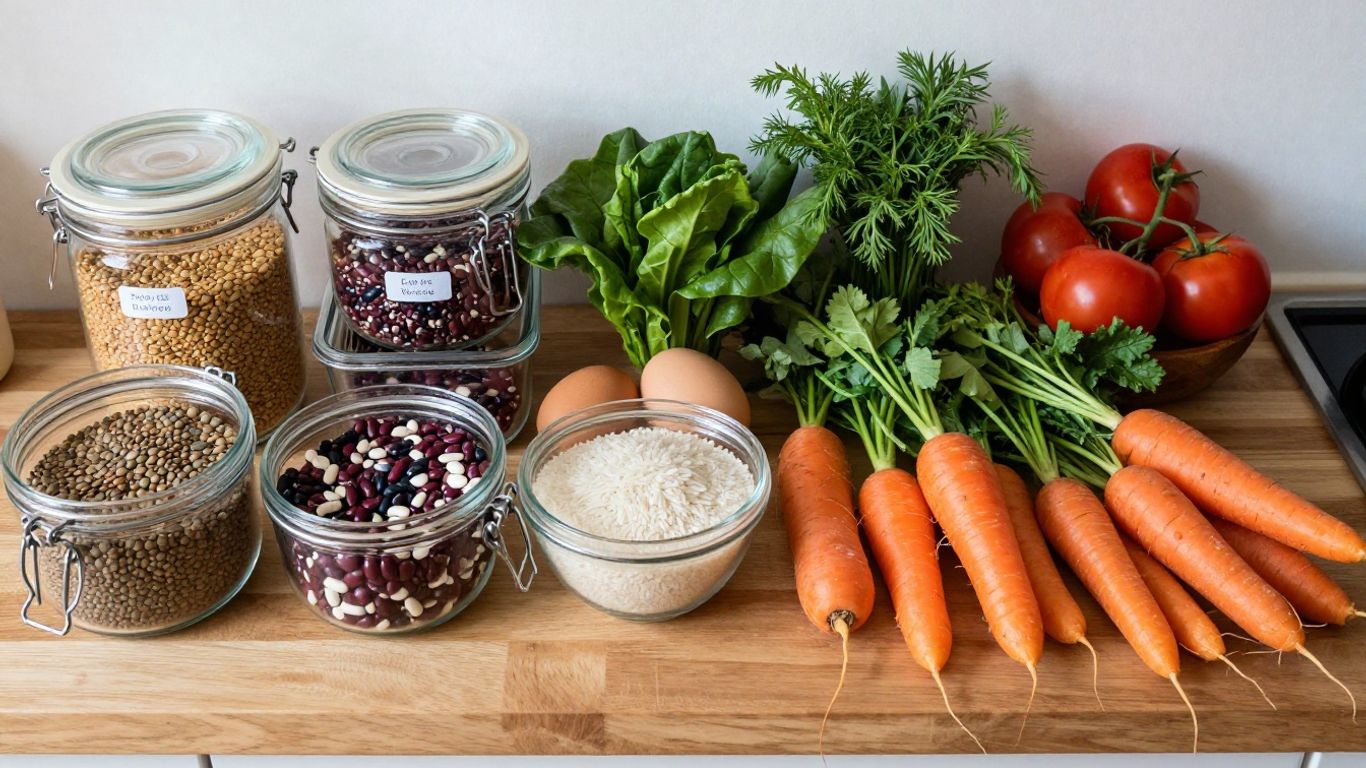
Prioritize beans, lentils, grains, eggs, and seasonal produce
Beans, lentils, grains, eggs, and seasonal produce make a sturdy foundation because they are versatile and easy to combine. They can become a warm bowl, a salad, a frittata, or a filling for wraps without requiring a separate shopping list for each meal. Seasonal produce is especially useful when it is plentiful, fresh, and happy to be roasted or simmered.
The cook need not treat these ingredients as worthy but joyless. A fried egg over rice, lentils folded through tomato sauce, or roasted pumpkin with a sharp dressing can be genuinely satisfying. Good seasoning does a great deal of heavy lifting for ingredients with modest price tags.
Compare unit prices instead of trusting flashy discounts
A bright discount label can be persuasive, but the unit price tells the less theatrical story. Comparing the cost per kilogram, litre, or item makes different packet sizes easier to judge and helps the cook avoid paying extra for clever packaging. It is a small habit with an outsized effect on a recurring shop.
The comparison should also include usable quantity. A bargain with a large amount of peel, liquid, or waste may not be as cheap as it first appears. Once the real yield is considered, the best choice is often clear without requiring a degree in supermarket detective work.
Buy family packs only when you can use or freeze them
Large packs can lower the cost per unit, but only when the household has a plan for the contents. The cook can divide meat, bread, grated cheese, or vegetables into sensible portions as soon as they arrive home, then refrigerate or freeze what will not be used promptly. Otherwise, the bargain quietly turns into a bin-side donation.
A useful rule is to name the future meals before buying the larger pack. If the chicken has a place in tonight’s tray bake, tomorrow’s wraps, and a labelled freezer portion, it is earning its keep. If it merely looks impressive in the trolley, the smaller pack may be the wiser purchase.
Turn leftovers and reduced-price ingredients into planned meals
Reduced-price ingredients are not a challenge to consume heroically before midnight. They are invitations to plan a dish that suits their condition: soft tomatoes can become sauce, tired greens can join a frittata, and leftover roast vegetables can fill a grain bowl. The meal should be decided while the ingredient is still useful, not after it has crossed into compost territory.
A short leftovers list on the fridge keeps these ingredients visible. The cook can pair each item with a likely destination and add only the missing basics. This makes the next meal feel intentional, even when it began with half a bunch of herbs looking slightly dramatic.
Pick recipes that stretch without tasting repetitive
The best batch recipes are flexible enough to change costume during the week. They rely on bases that reheat well, seasonings that can shift direction, and textures that do not collapse after one night in the fridge. Variety comes from assembly and finishing touches, not from purchasing twenty-seven specialist ingredients.
Make versatile bases such as rice, roasted vegetables, and tomato sauce
Rice, roasted vegetables, and tomato sauce can support several meals with remarkably little fuss. Each can be cooked in a useful quantity, cooled appropriately, and paired with different proteins, legumes, herbs, or toppings. They are the quiet workhorses of the budget kitchen, rarely glamorous but consistently employed.
The cook should keep some components plain enough to travel. A neutral grain can take on curry spices, lemon and herbs, or a smoky dressing later. Likewise, an uncomplicated tomato sauce can become pasta sauce one day and the base of a bean stew the next.
Use one-pot meals to save time, energy, and washing-up
One-pot meals reduce chopping boards, pans, and the number of objects waiting sternly in the sink. They are particularly useful for beans, lentils, soups, stews, and rice dishes where ingredients can share cooking time and seasoning. Less washing-up also makes a second batch-cooking session feel less like a punishment.
The cook should still think about texture. Adding quick-cooking vegetables near the end, or finishing with fresh herbs, can keep a one-pot dish from becoming uniformly soft. A single pot does not require a single texture, thankfully.
Add inexpensive flavor with spices, herbs, and sauces
Flavour does not have to arrive in an expensive jar with a foreign postcode. Garlic, ginger, chilli, vinegar, mustard, stock, dried herbs, and toasted seeds can change the character of familiar ingredients. A small finishing ingredient often does more for a meal than another costly main component.
A sensible pantry contains a few flavour directions rather than every spice on the shelf. The cook might keep one smoky blend, one warm curry-style blend, a sharp vinegar, and a creamy or spicy sauce. That modest collection can make the same roasted vegetables feel surprisingly sociable.
Remix the same batch into bowls, wraps, soups, and pasta
Remixing protects the household from leftover fatigue. Beans and roasted vegetables can become a bowl with rice, a wrap with salad, a soup with stock, or a pasta sauce with tomatoes. The underlying batch stays economical while the format changes enough to keep lunch from feeling like a rerun.
A useful sequence moves from crisp to soft. The freshest portions can go into bowls and wraps early in the week, while later servings can become soups or pasta where reheating is part of the design. That is not disguising leftovers; it is giving them a second job description.
Organize your cooking session like a tiny food factory
A calm cooking session is mostly a matter of order. The cook does not need a commercial kitchen, matching containers, or a stopwatch with opinions. A clear sequence reduces idle time, keeps hot equipment from competing for attention, and leaves enough energy to clean up before the bench becomes a topographical map of onion skins.
Prep ingredients in the order that saves the most time
The session should begin with a quick inventory and a reading of every recipe or component. Ingredients can then be washed, peeled, chopped, and grouped according to when they are needed. Starting with the longest tasks, such as oven roasting or simmering, gives the shorter preparations somewhere useful to happen.
Bowls or trays can hold ingredients by destination rather than by food type. One tray for the roast vegetables and another for the soup means fewer frantic searches and fewer chances of putting the cumin in the wrong pot. It is humble organisation, but it keeps the cook moving.
Cook multiple components at once
Batch cooking becomes worthwhile when several jobs overlap. While a tray roasts, rice can simmer and a pot of eggs can cook; while those settle, the cook can wash greens or portion dry ingredients. The goal is not speed for its own sake, but fewer separate cooking events during the week.
The cook should avoid filling every burner and rack without a plan. A crowded kitchen creates bottlenecks, especially when hot pans need somewhere safe to land. Two or three coordinated components are usually more useful than an ambitious spread that demands constant supervision.
Use a simple timeline to prevent kitchen traffic jams
A rough timeline can be written on paper or kept beside the chopping board. It should show what starts first, what needs stirring, and when each item can cool or be packed. The list does not need military precision; it only needs to prevent the rice, oven, knife, and cook from requesting the same square metre at once.
A compact sequence might look like this:
- Start the longest-cooking grain or legume.
- Put the roasting tray into the oven.
- Chop ingredients for the stovetop dish.
- Prepare sauces, garnishes, and storage containers.
Once the order is visible, the session feels less like improvisation and more like a gentle production line. The cook can adjust the timing without losing the plot, which is the real luxury here.
Know when convenience foods are worth the splurge
Convenience is not automatically wasteful. Frozen vegetables, pre-washed greens, tinned beans, and ready-made pastry can be sensible purchases when they prevent unused ingredients or make a batch possible on a busy day. The right question is whether the convenience will be used rather than whether it sounds virtuous.
Cost should be weighed alongside time and waste. A slightly dearer item that gets cooked and eaten may offer better value than a cheaper ingredient that requires an ambitious preparation and expires untouched. Frugality should reduce waste, not turn dinner into an endurance event.
Portion, store, and freeze meals safely
Storage is part of the recipe, not an afterthought performed with one hand while answering a message. Suitable containers, clear labels, and prompt cooling help protect both the food and the money spent on it. A batch is only a saving when it remains appealing and usable.
Choose containers that match your serving sizes
Containers should suit the portions the household actually eats. Smaller boxes can hold lunches or sides, while larger ones may suit family dinners; shallow containers often make cooling and reheating more manageable. Matching the container to the meal also reduces the temptation to thaw far more food than needed.
A modest collection of stackable containers keeps the fridge easier to read. Leak-resistant lids are particularly useful for soups and sauces, because a mysterious tomato lake is not a storage system. The best container is the one that gets used repeatedly and survives the week without drama.
Label meals with names and dates
Labels prevent the freezer from becoming a museum of unnamed intentions. Each portion should have the meal name and the date it was stored, with extra notes where reheating or serving suggestions matter. A marker and a small strip of tape are enough; no bespoke stationery is required.
The cook can place newer meals behind older ones and check the freezer before cooking another batch. This first-in, first-out habit keeps the stored food moving and makes forgotten portions much less likely.
Cool and refrigerate cooked food promptly
Cooked food should be divided into suitable portions and refrigerated promptly rather than left sitting out while the kitchen is admired. Smaller, shallow containers can help it cool more efficiently, and the refrigerator should not be overloaded with steaming-hot dishes. When in doubt about a food’s condition, caution is kinder than optimism.
The cooling stage also deserves a clean, clear bench. Packing food while it is still intensely hot can create practical problems, but delaying storage for hours is no improvement. A tidy transition from cooker to container keeps the process both safer and easier to repeat.
Freeze ingredients and finished meals for future busy days
Freezing works for more than completed dinners. Bread, chopped herbs, cooked grains, portions of meat, and some vegetables can be stored for later use, provided they are packed well and labelled. This gives the cook a reserve of useful components instead of one giant block of something that might once have been soup.
Finished meals should be frozen in portions that match likely occasions. A single serve is handy for a workday, while a family portion may suit a night when everyone arrives hungry. Thawing and reheating instructions written on the label can make the future cook unusually grateful to the past one.
Keep costs down without sacrificing nutrition
A cheap meal can still be balanced, colourful, and satisfying. The budget works better when the cook considers the whole plate rather than chasing the lowest price for one ingredient. Filling food should have enough variety to carry the household through the week without making every meal feel like a compromise.
Balance carbohydrates, protein, vegetables, and healthy fats
A practical meal can combine a carbohydrate base, a protein source, vegetables, and a modest amount of healthy fat. Rice, oats, potatoes, pasta, beans, lentils, eggs, tinned fish, vegetables, nuts, seeds, and olive oil can all contribute in different combinations. The exact mix will vary with preference and appetite, but balance remains a useful planning lens.
Thinking in components also helps the cook spot gaps before shopping. If the menu contains plenty of rice but little protein or produce, the adjustment can be made early and cheaply. No elaborate nutrition spreadsheet is needed, only a glance at what will make the meal satisfying.
Bulk out meat dishes with beans, grains, or vegetables
Meat dishes can stretch further when beans, grains, mushrooms, lentils, or finely chopped vegetables join the mixture. They add texture and substance while allowing a smaller amount of meat to flavour a larger pot. Chilli, bolognese, meatballs, and shepherd’s-pie-style fillings are especially adaptable.
The addition should feel deliberate rather than apologetic. Good seasoning, careful browning, and a suitable sauce can make the expanded dish taste complete. The household should notice a satisfying dinner, not a desperate attempt to make one ingredient impersonate three.
Use affordable flavor boosters instead of expensive specialty ingredients
A few inexpensive flavour boosters can make familiar meals feel new. Lemon or vinegar can sharpen a rich dish, toasted spices can wake up beans, and fresh herbs can lift a grain bowl. Stock powder, chilli, garlic, mustard, and a spoonful of yoghurt or tahini can also add character without filling the cupboard with one-use purchases.
The cook should buy specialty ingredients only when there is a clear plan for using them again. An ingredient that appears in one recipe and then retires to the back of the fridge is rarely a bargain, no matter how exciting it looked in the shop.
Watch for false savings in oversized portions and food waste
A large batch is not automatically economical. If portions are too generous, the household may tire of the meal, leave food uneaten, or rely on expensive snacks later. The cook can begin with moderate servings and keep a little extra separately, allowing appetite to decide rather than guessing boldly.
Food waste also includes ingredients bought for an imaginary future. The cook should inspect the fridge before shopping, use the most perishable items first, and freeze suitable extras while they are still appealing. Saving money is often less about finding a miraculous bargain than about finishing what has already been paid for.
Make batch cooking work week after week
A sustainable routine should be repeatable on an ordinary weekend, not only during a burst of domestic enthusiasm. The cook can keep the useful parts, discard the fussy ones, and adjust the system as work, weather, and appetites change. Consistency comes from making the process fit real life.
Track which meals saved money and which missed the mark
A brief note after each batch can reveal more than a complicated plan. The cook might record which meals were eaten happily, which ingredients went unused, and which portions were too large or too small. This creates a practical record based on the household’s behaviour rather than assumptions.
The notes should be honest but not dramatic. A meal that was cheap yet universally ignored has not earned a permanent place, while a plain soup that vanished quickly may deserve a repeat. The best budget system learns from both triumphs and the occasional container of regret.
Rotate a small collection of reliable recipes
A small group of dependable recipes reduces planning fatigue and makes shopping more predictable. The rotation can include a soup, a tray bake, a bean or lentil dish, a grain-based meal, and a flexible egg option. Each can change with seasonal produce and available pantry staples.
Repetition is not the enemy when the finishing touches vary. Different sauces, herbs, toppings, and serving formats can give familiar foundations a fresh accent without adding much cost or work. The cook is building a repertoire, not auditioning for a cooking show.
Adjust portions for workdays, weekends, and changing appetites
Portions should reflect the week ahead. Workday lunches may need to be compact and portable, while weekend meals can be assembled fresh or shared more casually. Household appetites also shift, so the plan should allow for a little flexibility instead of treating every person as a perfectly predictable unit.
The cook can freeze a few portions before the week begins if demand is uncertain. That protects the food from being rushed through and provides a useful fallback when plans change. A freezer portion is a small act of kindness from one day to another.
Refresh frozen meals so they do not become freezer fossils
Frozen meals need a rotation date, not just a vague promise that someone will remember them. The cook can review the freezer regularly, move older portions forward, and schedule them into the coming week. Adding a fresh salad, herbs, toast, or a quick sauce can make a thawed meal feel less like an archaeological discovery.
If a particular dish repeatedly lingers, the system has supplied useful information. Perhaps the texture changes after freezing, the portion is inconvenient, or the recipe simply lacks appeal. Replacing it is not failure; it is how a batch-cooking routine becomes more accurate over time.
Conclusion
Batch cooking on budget is a collection of small, sensible decisions: plan overlapping ingredients, compare real prices, cook components in a useful order, and store food so it remains easy to eat. The strongest routine leaves room for substitutions, changing appetites, and the occasional night when cereal wins. With a little practice, the big batch becomes less a chore than a quiet favour the cook leaves for the rest of the week.